



日本で働くために知っておきたいこと(What You Need to Know About Working in Japan)
In Japanese companies, “reliability as an organization member” is valued just as much as—if not more than—individual skills (such as drawing ability or creativity).
そこで今回は、卒業後も日本に残って働きたい留学生や、日本で就職を希望する海外の学生に向けて、「日本で働くために知っておきたいこと」を3つのポイントにまとめてみました。
Therefore, we have summarized “What you need to know about working in Japan” into three key points for international students who wish to stay and work in Japan after graduation, as well as overseas students hoping to find employment here.
明日から使えるアクションプランも併せてまとめてみましたので、参考にしてくださいね。
We have also included actionable plans that you can start using tomorrow, so please use them as a reference!
1.長期的な雇用が前提(Long-Term Employment as a Premise)

日本の企業では、採用にあたって長期的な雇用を前提にすることが多く、入社後数年おきに配置転換(ジョブローテーション)を行うことで、従業員が成長し続けることが期待されています。
When hiring, Japanese companies usually assume long-term employment. Employees are expected to keep growing by undergoing job rotations every few years after joining the company.
そのため、企業は新入社員に対してOJTや研修などの充実をはかり、スキルを積み重ね、将来的に組織の中核を担う人材へと育てることを目指します。
For this reason, companies focus on providing extensive OJT (On-the-Job Training) and training programs for new hires.
Their goal is to help employees build their skills so they can grow into talent that will anchor the core of the organization in the future.
実際に、本校にも10年、20年、30年と長期に働いているスタッフが複数在籍し、研修やジョブローテーションを通じて、キャリアの選択肢を広げています。
In fact, our school group has several staff members who have been working here long-term—for 10, 20, or even 30 years—broadening their career options through training and job rotations.
👉️アクションプラン(Action Plan)
面接対策として「あなたの5年後、10年後のキャリアプラン」を語れるようにしておきましょう!
As part of your interview preparation, make sure you can talk about your “5-year and 10-year career plans!”
2.時間厳守(Strict Punctuality)

日本の企業には、「遅刻=相手の時間と信頼を奪う失礼な行為」という強い認識があります。
In Japanese companies, there is a strong cultural understanding that “being late = a disrespectful act that steals the other person’s time and trust.”
例えば、企業説明会や採用面接時に、電車遅延や交通渋滞などの理由だったとしても、次の機会が得られない場合があります。
For example, if you are late for a company information session or a job interview—even if it is due to train delays or traffic jams—you may not be given a second chance.
またこのことは、クリエイターとして制作物の納品期日を守ることにも繋がります。
Furthermore, this concept directly ties into your ability as a creator to meet deadlines for your deliverables.
👉️アクションプラン(Action Plan)
学校の提出課題の締切期限を守り続けよう!
Always meet your school assignment deadlines!
3.チームワーク(Teamwork)

日本の企業では、組織全体で成果を上げることが重要視されているため、円滑なコミュニケーションや助け合いが仕事の効率や質を高めると考えられています。
Because Japanese companies emphasize achieving results as an entire organization, smooth communication and mutual support are believed to improve the efficiency and quality of work.
日本で働きたい人が、実際に日本で働いた時に、職業分担やジョブディスクリプションが見えにくく感じるのはこのせいかも知れません。
When people who want to work in Japan actually start doing so, this cultural difference might be why they find division of labor and job descriptions a bit vague or hard to see.
採用面接においても、入社前の段階ではスキルよりもチームワークができる人かどうかを重要視する傾向があります。
Even during job interviews, companies tend to prioritize whether you are a team player over your technical skills at the pre-employment stage.
👉️アクションプラン(Action Plan)
面接対策として「周りの人と意見が食い違った場合あなたはどう対処するか?」を語れるようにしておきましょう!
As part of your interview preparation, make sure you can answer: “How do you handle situations where your opinion differs from those around you?”
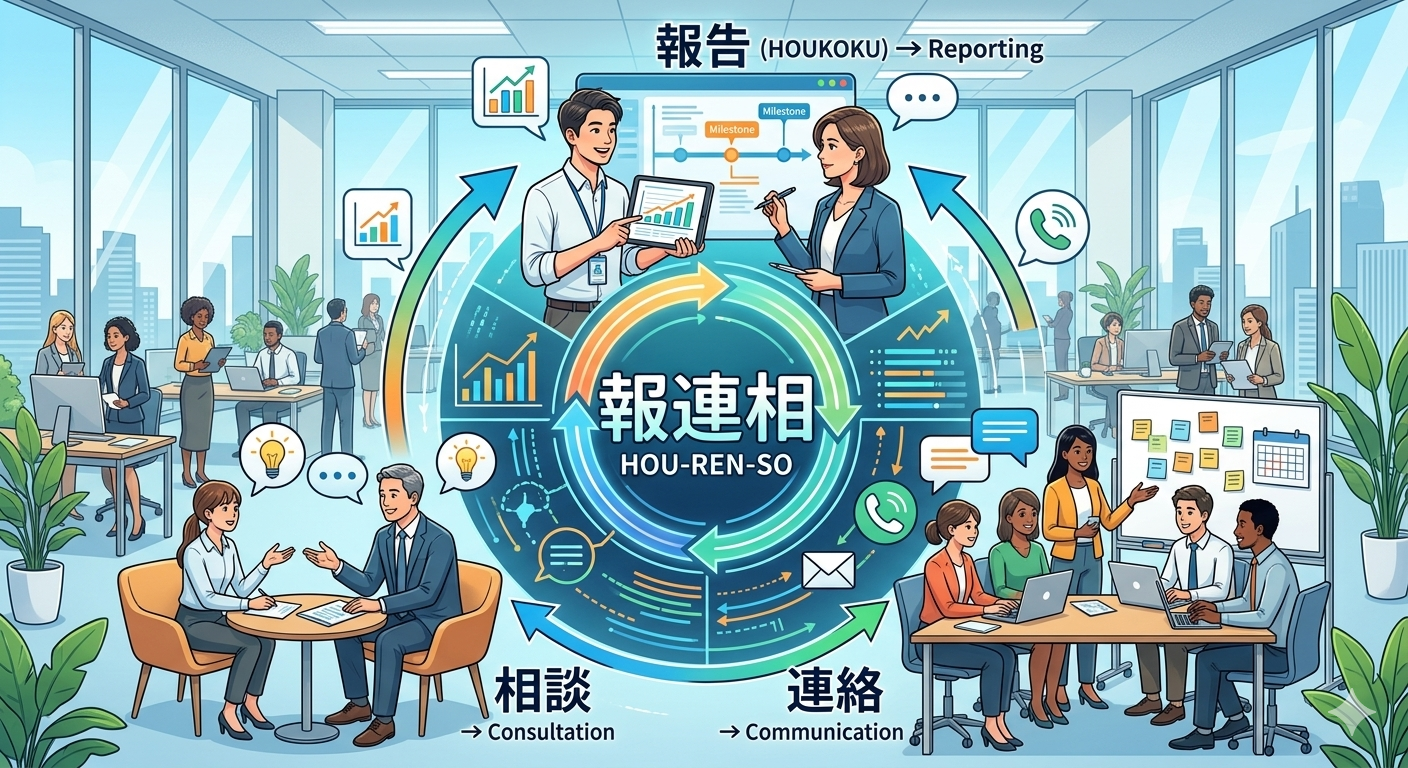
最重要コミュニケーション「報連相」(The Most Important Communication: “Hou-Ren-So”)
クリエイティブな現場であっても、仕事はチームプレイです。
Even in creative fields, job is based on team work.
プロジェクトの進行を止めないための報連相(ほうれんそう)を覚えておきましょう。
Remember the “Hou-Ren-So” (Report, Contact, Consult) framework to keep project progress from stalling.
報告 (Houkoku) – Report
業務の進捗や結果を上司や周りの人に伝える。
Inform your supervisor and colleague about your work progress and results.
ミスをしてしまった時の「悪い報告」ほど、速やかに報告しよう。
Bad news, such as mistakes, should be reported as quickly as possible.
連絡 (Renraku) – Contact / Inform
必要な情報や事実を共有し、個人的な意見や推測を交えずに状況を知らせる。
Share necessary information and facts to update others on the situation, without mixing in personal opinions or speculation.
相談 (Soudan) – Consult
自分だけでは判断に迷う時に、上司や先輩にアドバイスを求める。
Seek advice from your supervisor or senior colleagues when you are unsure or hesitant to make a decision on your own.
私たち学校法人呉学園グループには、TomodachiLinkがあります、ひとりで抱え込まずにキャリアセンターに相談してくださいね!
Within our educational institution, the Go Gakuen Group, we have TomodachiLink. Don’t bottle things up by yourself—please reach out and consult with the Career Center!
まとめ(Summary)
インターン生や新人が最初に勝ち取るべきことは、高度なプロの技術だけでなく、「この人には安心して仕事を任せられる」という信頼感を相手に印象づけることです。
The first thing interns and fresh graduates should strive to earn is not advanced technical skill, but the absolute trust that leaves others feeling confident saying, ‘I can hand this job over to them without a worry.’
どんなに個人の作業に見えるクリエイティブな仕事でも、最後はチームで一つのものを作り上げます。
No matter how much a creative job looks like solo work on the surface, in the end, it takes a team to build a final product.
報連相ができる人は、周囲と上手く協調でき、どんな現場でも活躍できます!
People who can practice Hou-Ren-So can collaborate well with those around them and thrive in any workplace!
PicoN!編集部 かみさく
(translator:Toh Wen Ping/NIPPON DESIGNERS SCHOOL MALAYSIA COLLEGE)
↓PicoN!アプリインストールはこちら